Overview
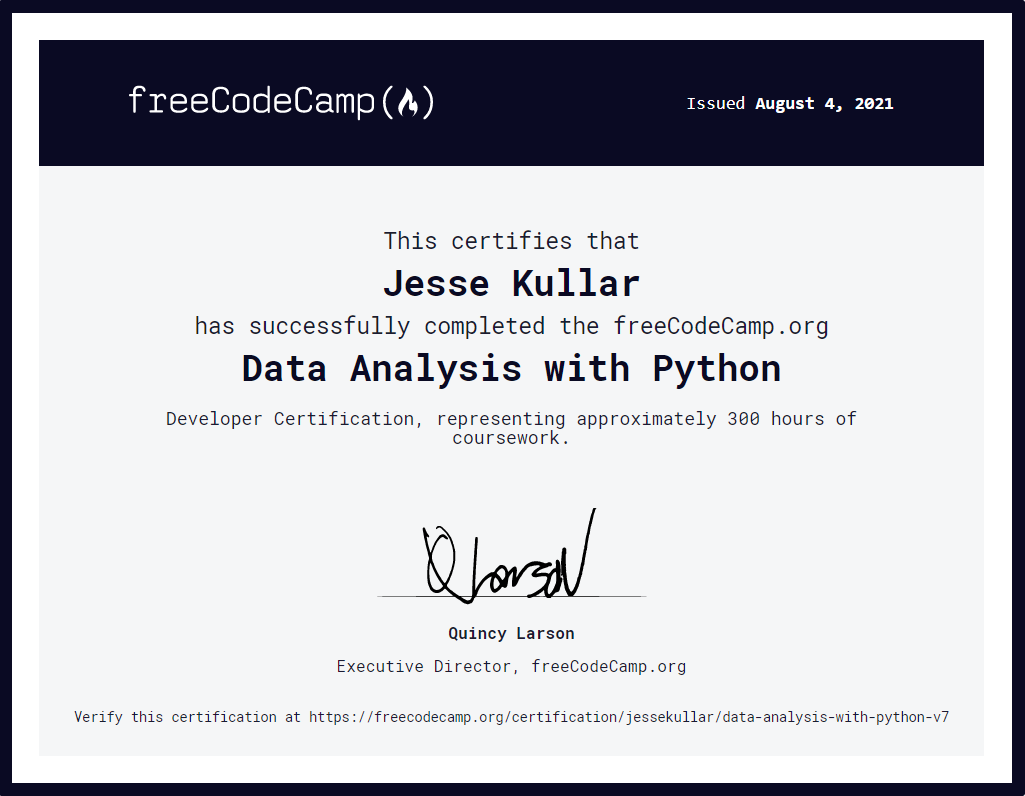
Once I had an established understanding of Python's fundamentals, I wanted to understand how Python is used for Data Analytics. Through FreeCodeCamp's Certification Course, Data Analysis with Python, I learned how to import and process data using Numpy and Pandas, and visualize it using Matplotlib and Seaborn.
With this course, I mastered working with and manipulating dataframes for data analysis. Despite already having an extensive understanding of data analysis by using Matlab for my college coursework, this course taught me how to use Python's libraries and syntax in a work setting. Although the projects below may seem rudimentary in nature, they taught me the proper syntax so I can use my knowledge of advanced data analytics from Matlab in the Python language.
Projects

Mean Variance STD Calculator
Created a function that uses Numpy to determine the mean, variance, std, max, min and sum of rows, columns, and elements in a 3x3 matrix.
Topics: Numpy, Array, Raising Exceptions, functions
Demographic Data Analyzer
Analyzed a set of demographic data from the 1994 Census database using Pandas.
Topics: Pandas, Dataframes, Indexing, Conditional Selection (.loc, .isin, etc.), Data Importing and Cleaning
Medical Data Visualizer
Visualized and made calculations from medical examination data using Matplotlib, Seaborn, and Pandas. Created a categorical plot and heat map with resulting data seeing impact of attributes on whether subject was overweight or not.
Topics: Matplotlib, Seaborn, Pandas, Dataframes, Data Normalization, Data Reformatting, Data Cleaning, Correlation Matrix
Time Series Visualizer
Visualized time series data containing the number of page biews each day on the freeCodeCamp.org forum using Matplotlib, Seaborn, and Pandas. The data analysis determined any trends in visits and identified yearly and monthly growth.
Topics: Matplotlib, Seaborn, Pandas, Dataframes, Data Cleaning, Data Visualization, Data Reformatting
Sea Level Predictor
Analyzed a dataset of the global average sea level change since 1880 and used this data to predict the sea level change through the year 2050 using linear regression.
Topics: Scipy, Matplotlib, Pandas, Dataframe, Linear Regression
Certification