Overview
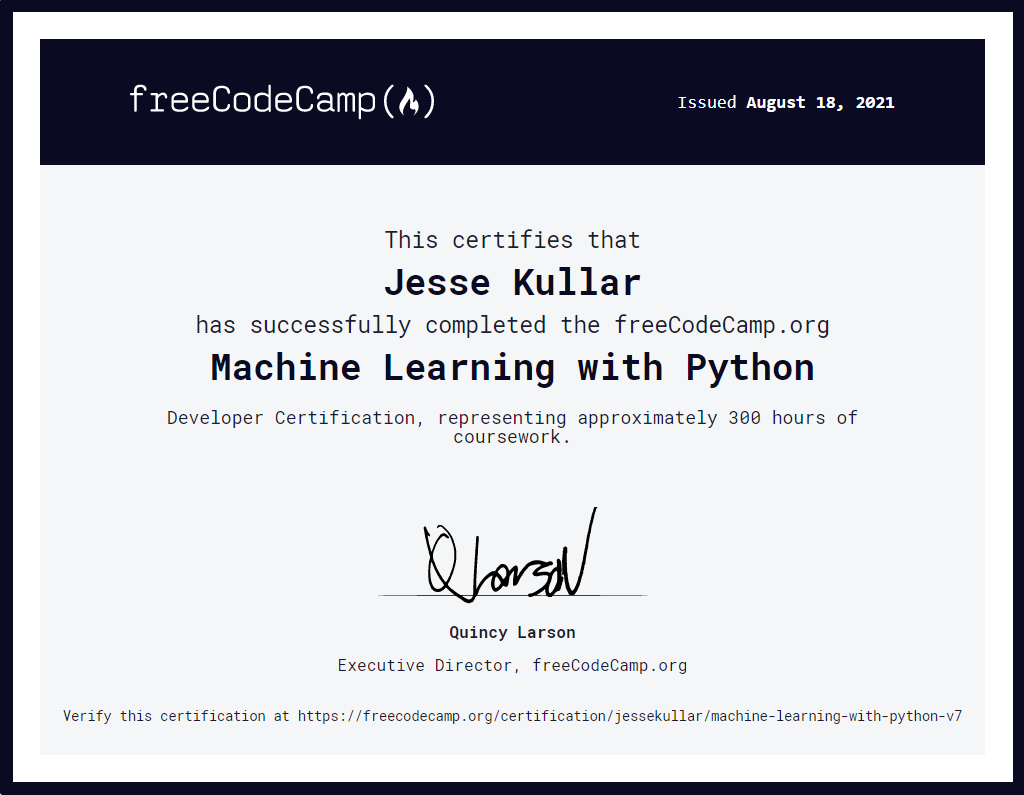
With Python and its libraries under my belt, I was eager and ready to dive into Machine Learning. Through FreeCodeCamp's Certification Course, Machine Learning with Python, I recieved a comprehensive education of various learning algorithms achieved through Python's machine learning library, Tensorflow.
This course taught me how to pre-process, train, and test the data. I covered Classification, Clustering, Hidden Markov Models, Convolutional Neural Networks (CNN), Recurring Neural Networks (RNN), Long Short Term Memory (LSTM), Q-Learning, and more. I learned about the different activation functions, optimizers, and methods of building the model depending on the data provided.
The projects below are a testament to my understanding of these machine-learning principles. With the knowledge I have gained, I plan to utilize the tools at my disposal and use machine-learning for data analysis and to improve user experiences online.
Projects

Rock Paper Scissors Bot
Created a program to play Rock, Paper, Scissors against 4 opponents that use different strategies. The program uses a Markov Chain model to achieve at least 60% accuracy against its opponents.
Topics: Markov Chain, Keras, TensorFlow, Numpy, Recursion, Itertools
Cat or Dog Image Classifier
Created a convolutional neural network (CNN) using TensorFlow and Keras to correctly classify images of cats and dogs with an accuracy of 72%. A Keras Sequential model uses Conv2D and MaxPooling2D layers with a Rectified Linear Unit (ReLU) activation function and Adam optimization algorithm to train the model.
Topics: CNN, Keras, TensorFlow, Pre-Processing, Image Transformations, Sequential Model, Conv2D, MaxPooling2D, Prediction, Loss
Book Recommendation Engine using KNN
Created a book recommendation algorithm using K-Nearest Neighbors and the user reviews from the Book-Crossings Dataset. This code takes a book title as an argument and returns a list of 5 similar books along with how closely related they are. The smaller the value, the more closely they are related.
Topics: Scipy, Scikit-Learn, DataFrames, Pre-Processing, K-Nearest Neighbors, Compressed Sparse Row Matrix
Linear Regression Health Costs Calculator
Used DNN-Regression to determine a person's healthcare costs based on their characteristics. A Keras Sequential model uses Dense layers with a ReLU activation function and adam optimization algorithm to train the model. The current model has a mean absolute error of about $2890.
Topics: DNN-Regression, TensorFlow, Keras, Pre-Processing, Sequential Model, Dense, Prediction, Mean Absolute Error
Neural Network SMS Text Classifier
Created a model using LSTM to classify SMS messages as legitamite or spam. The data for this model was obtained from the SMS Spam Collection Dataset. Currently the model is able to determine the legitmacy of texts with an accuracy of 99%.
Topics: TensorFlow, Keras, DataSets, Pre-Processing, Encoding Text, Recurrent Neural Networks, Long Short Term Memory
Certification